Microservices vs. Monoliths: Making the Right Architectural Choice
An objective analysis of when to choose microservices or monolithic architecture based on business requirements and team capabilities.
As software systems grow in complexity, architecture becomes a critical decision for long-term success. The debate between microservices and monoliths has shaped modern software development, often with strong opinions on both sides. But choosing the right architecture isn't about trends—it's about understanding your business needs, technical constraints, and team maturity.
This article provides an objective analysis of both approaches and helps you decide when to go monolith and when microservices make sense.
🧱 What is a Monolithic Architecture?
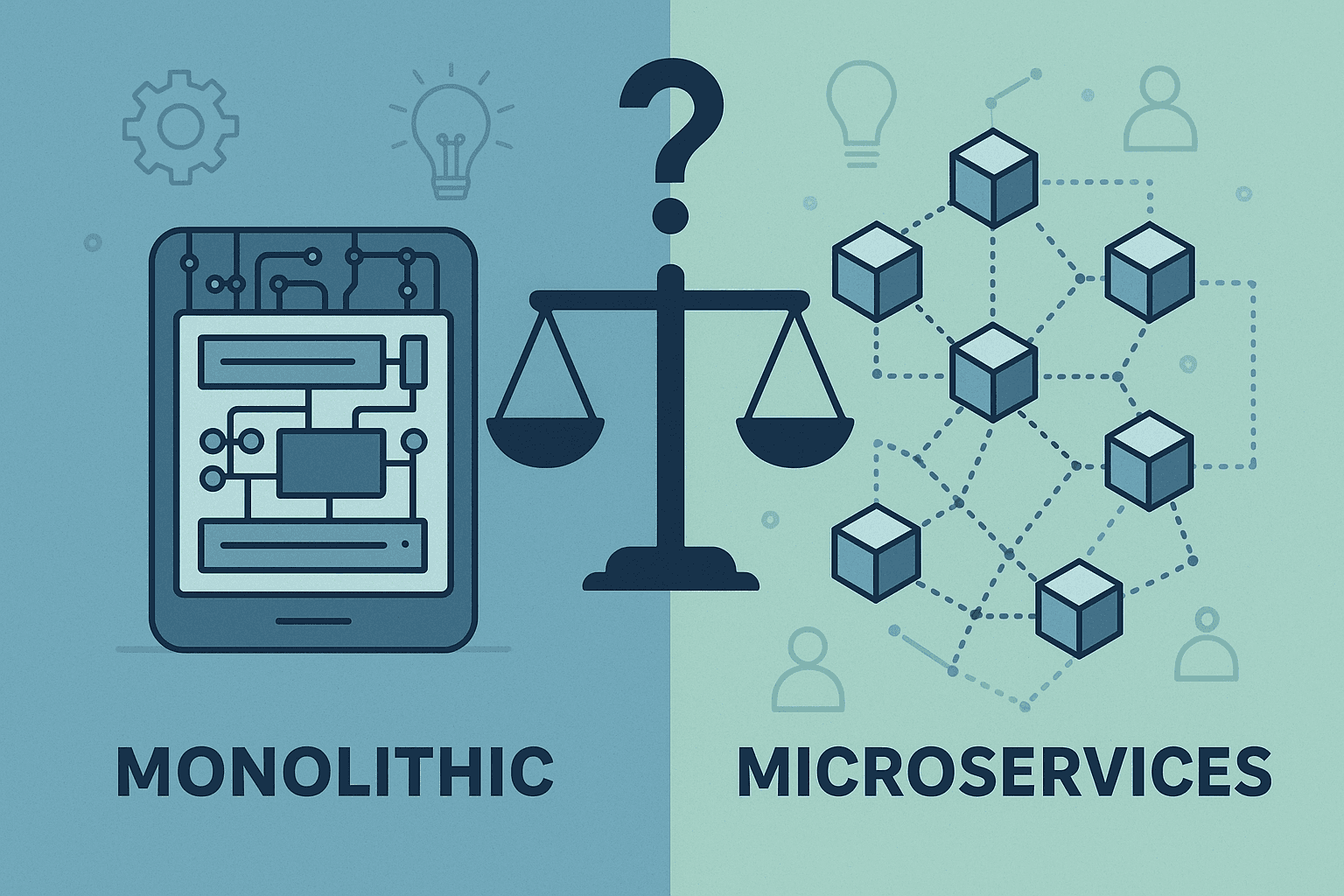
A monolithic application is built as a single, unified unit. All features—authentication, business logic, UI, data access—are packaged together and deployed as one application.
✅ Pros of Monoliths:
- Simplicity: Easier to develop, test, and deploy.
- Performance: No inter-service communication overhead.
- Less DevOps Overhead: Fewer moving parts = simpler infrastructure.
- Ideal for Small Teams: Fewer coordination points across developers.
❌ Cons of Monoliths:
- Scaling is Coarse: You scale the whole app, even if only one module is under load.
- Harder to Maintain Over Time: As codebase grows, separation of concerns becomes fuzzy.
- Slower Deployment Cycles: One change may require redeploying the whole system.
- Team Coordination Challenges: Difficult to parallelize work among large teams.
🧩 What is a Microservices Architecture?
Microservices break the application into small, independent services—each responsible for a specific business capability and communicating via APIs.
✅ Pros of Microservices:
- Independent Deployments: Teams can release features autonomously.
- Scalability: Services scale independently based on need.
- Better Fault Isolation: A failure in one service doesn’t bring down the whole system.
- Technology Diversity: Teams can use different languages or databases per service.
❌ Cons of Microservices:
- Operational Complexity: Requires advanced DevOps practices (e.g., CI/CD, service discovery, centralized logging).
- Distributed System Challenges: Network failures, latency, data consistency.
- High Initial Setup Cost: More effort in building infrastructure and automation.
- Monitoring and Debugging is Harder: You need observability tools from day one.
🎯 How to Choose: Key Factors to Consider
1. Team Size & Maturity
- Small Team / Startup: Go Monolith.
- Large or Scaling Team with DevOps Expertise: Consider Microservices.
2. Product Maturity
- Early-stage product with evolving features: Monolith helps iterate faster.
- Mature product with clear domain boundaries: Microservices offer better agility.
3. Deployment Frequency
- If different teams want to deploy independently and frequently, microservices are advantageous.
4. Scalability Needs
- Microservices allow scaling hot paths (e.g., search, payment) without touching others.
5. Organizational Structure
- Conway's Law suggests your architecture will reflect your team structure. Decentralized teams align better with microservices.
6. Tooling & Infrastructure Readiness
- Monoliths need minimal tooling.
- Microservices demand service mesh, monitoring, logging, CI/CD, and robust testing.
🧠 Real-World Scenarios
Scenario
Recommended Architecture
A startup building MVP with 4 developers
✅ Monolith
An e-commerce platform with thousands of daily users and domain-specialized teams
✅ Microservices
A SaaS tool exploring product-market fit
✅ Monolith (initially)
A logistics company with legacy systems and integration-heavy workloads
✅ Microservices, with an API gateway
🔄 A Hybrid Approach?
Some companies adopt a modular monolith to combine the best of both worlds:
- Start with a well-structured monolith.
- Identify domains with scaling or complexity issues.
- Gradually extract them as microservices.
This “monolith-first, microservices-when-needed” approach is proven by companies like Shopify, Uber, and Amazon.
🧭 Final Thoughts
There's no one-size-fits-all answer. Here's the bottom line:
- Start monolith if you're building something new, small, or rapidly changing.
- Move to microservices when your product, team, and infrastructure demand it.
Don’t choose microservices because they’re trendy. Choose them because your business needs flexibility, scale, and autonomy—and you have the team maturity to handle the complexity.
💬 What architecture are you using today—and why?
Share your thoughts or experiences in the comments. Let’s help each other make better technical decisions!
Put this into practice
Get a free AI audit for your business
A 30-minute call with an engineer to find the first automation worth building.